AI Model Choice: Large, Medium or Small for Each Job
AI models are split into large, medium and small tiers. See which job belongs on which tier, using the Claude 5.5 family as the worked example.
rabbitclip teamPublished: 6 min read
Short answer
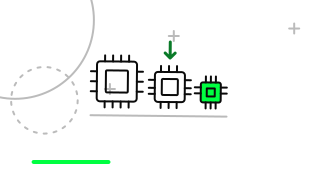
AI model families now generally come in three tiers: a large model for complex work that needs careful judgement, a medium model for most everyday tasks, and a small model for high-volume jobs where speed counts. For a business, the right choice is not to put the strongest model everywhere but to give each job to its own tier, which lowers both cost and waiting time.
In this article we use Anthropic's Claude 5.5 family, released in September and October 2026, as the example: Opus 5.5, Sonnet 5.5 and Haiku 5.5. We could not reach official pages for other providers' October 2026 releases, so for them we say only that they offer similar tiers and give no version names or figures.
Below you will find what each tier is good for, how to divide the work, the mistakes made most often and when this split is not needed. Every figure comes from Anthropic's own pages and its own measurements; none of it is an independent test.
What do large, medium and small models mean?
Models in the same family work in the same field but strike different balances. A large model thinks more and makes fewer mistakes on hard work, but costs more and is slower. A small model is fast and cheap but struggles with complex, multi-step work. A medium model sits between the two, at a sensible point for most daily tasks.
Think of an office: you do not send every letter to a senior specialist. The quick member of the team does the routine work and the specialist takes the hard decision. Choosing a model is the same division of labour.
What is Claude Opus 5.5 for?
According to Anthropic's page dated 22 September 2026, Opus 5.5 performs at the level of Claude Fable 5.1 on most work and costs 40% less to run than Opus 5. The page recommends it for complex work that needs careful judgement.
For a business that means comparing contract drafts, synthesising research from many sources, or preparing an analysis that cannot tolerate error. For decisions that are low in volume but high in value, the large tier is a reasonable investment.
Where does Claude Sonnet 5.5 sit for everyday work?
Anthropic's page dated 28 September 2026 says Sonnet 5.5 generates outputs more than 30% faster than Sonnet 5 and costs up to 30% less per task, which it attributes to spending fewer tokens. It is described as strongest at well-scoped everyday tasks, fixing bugs and creating polished documents, including presentations and spreadsheets.
Sonnet 5.5 is available on all platforms, including AWS, Google Cloud and Microsoft Azure, and there is a zero data retention option. That is a detail worth discussing for any business that works with customer data. For most businesses, this is where the default model will sit.
What does Claude Haiku 5.5 give you for high-volume work?
Anthropic's page dated 7 October 2026 presents Haiku 5.5 as the cheapest, fastest and most capable small model the company has released. It says the model now costs around 75% less to run on average than Haiku 4.5. The recommended jobs are high-volume ones such as summarising, compressing, database queries and classification, and speed-sensitive ones such as live customer support and browser use.
The same page recommends Sonnet or Opus rather than Haiku for complex agentic coding. In other words, a small model is good for sorting thousands of incoming emails by subject, but it is not the right choice for running a multi-step software job.
- Sorting incoming messages by subject
- Turning long texts into short summaries
- A fast first reply on a live customer support screen
- Preparing database queries
How do you divide work between the tiers?
The practical way is to sort work by difficulty rather than by arrival order. A small model classifies every incoming request and answers the simple ones itself; a request that looks hard moves up to the medium or large model. That way the expensive model runs only when it is truly needed.
Before dividing, prepare an evaluation set: examples chosen from your real work, each with its correct answer. Try every tier on that set; if the small model does the job well enough, there is no reason to pay for the larger one. Cost control is a separate subject, so remember to set usage limits and to watch spending regularly.
What mistakes are common, and when is this split unnecessary?
The most common mistake is giving every job to the largest model, which inflates both the bill and the waiting time for no reason. The reverse is also a mistake: handing a complex job to the smallest model to save money gives the saving back in correction effort. Another is judging by the provider's promotional page and deciding without trying the models on your own work.
Most small businesses do not need this split. If you prepare a few documents a month, a single medium model is enough; managing tiers earns its keep only when volume grows. Other providers offer similar tiers as well; the principles are the same, but you should check current versions on their own official pages.
Choosing a model is not a brand preference but a decision about dividing the work: hard and valuable jobs go to the large model, everyday jobs to the medium one, and high-volume jobs that need speed to the small one. First build an evaluation set from your own work, test the tiers against it, then watch the spending. If you would like to work out together which of your jobs falls on which tier, we are glad to have a calm discovery conversation with you at rabbitclip.
FAQ
Which AI model should I choose?
For most everyday work, the medium tier is a good starting point. Give high-volume simple jobs to the small model and complex jobs that cannot tolerate error to the large one. Base the decision on a trial with your own sample jobs.
When is a small model not enough?
On complex, multi-step work. Anthropic's Haiku 5.5 page recommends Sonnet or Opus for complex agentic coding. For summaries, classification and quick customer replies, a small model is a good fit.
How much cheaper is Haiku 5.5?
According to Anthropic it costs around 75% less to run on average than Haiku 4.5. That is the company's own measurement, and the real cost on your own work may differ. Check the price table on Anthropic's page.
Do other providers' models split into the same tiers?
They offer similar tiers, but we could not reach official pages for their October 2026 releases, so we give no version names or figures. Take current information from each provider's own pages.
What is an evaluation set and why do I need one?
It is a small list of examples taken from your real work, each with its correct answer. It lets you see which tier does the job well enough by looking at your own data rather than at a promotional page.
Sources
The specific facts in this article rest on these official pages; check them for the current position.