What Are AI Agents and What Do They Do in a Workflow?
What an AI agent is, how it differs from a chatbot, which workflow steps it can take on, and where human approval and data protection still apply.
rabbitclip teamPublished: 6 min read
Short answer
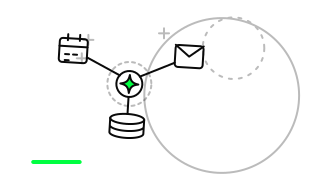
An AI agent is software that takes a goal, breaks it into steps, chooses and uses tools such as email, calendars, spreadsheets or internal systems to carry those steps out, and looks at each result before deciding what to do next. It differs from a chatbot in that it does work rather than only producing answers. It can also be wrong: it may misread a document, pick the wrong tool, or sound certain when it is not. A well-built agent therefore comes with written limits and a person who approves the steps that matter.
The subject is often described in grand terms. This piece looks instead at the questions an owner or manager should ask: what exactly does an agent do, which jobs suit it and which do not, and how is sensitive data protected once an agent can reach it. It is written as a decision guide, not a product pitch.
How does an agent differ from a chatbot or classic automation?
Classic automation follows a fixed recipe: when this happens, do that. The steps are written in advance and it never leaves the recipe. A chatbot takes a question, produces an answer and stops there. An agent sits between the two: it is given a goal, plans the steps itself, and can change the plan after seeing what each step returned.
That flexibility brings both strength and risk. A fixed recipe does the same thing every time, so it is easy to audit. An agent can reach the same goal by different routes, which helps in unexpected situations but makes its behaviour harder to predict in advance. Which one you choose depends on whether the job rewards flexibility or predictability.
Which workflow steps can an agent take on?
Agents help most with work that means moving information between several tools and joining it with small decisions. Picture a spa group: an incoming booking request is read, the diary is searched for a free slot, a draft reply is prepared for the guest and a summary is left for the team. Each step is small; the effort lies in going back and forth between them.
Typically, these kinds of jobs suit an agent:
- Sorting incoming requests by topic and routing them to the right person
- Gathering information from several sources and preparing a short summary or draft
- Matching records between spreadsheets and systems and flagging what is missing
- Drafting routine replies and putting them in front of a person for approval
- Finding and listing records that break a given rule
Where does an agent make mistakes?
The language models behind agents can produce information that does not exist, and do so convincingly. In a single answer that problem is easy to spot. In an agent, a wrong step is carried into the steps after it, and the end result can look tidy while being flawed at its root. Errors compound, and tracing them back gets harder.
Context is the other weak point. An agent knows only what it has been shown: not the problem a customer had last month, the unwritten understanding in a contract, or the habits of your team. An agent acting confidently on partial information does not stop where an experienced colleague would stop by instinct.
Where is human approval needed, and how is sensitive data protected?
Approval is needed at every step that cannot be undone: a message sent to a customer, a payment, deleting a record, a contract or a price commitment. The agent drafts these and a person reads and approves them. Steps that are reversible and low risk, such as creating a draft or tagging a record, can go without approval. The line is drawn by what a mistake would cost.
For sensitive data the principle is narrow access. The agent gets only the systems and fields its job needs; identity details, health information and financial records are left out or masked wherever possible. Every action it takes should be logged, so that you can later see who looked at what and what was done.
Which data may be sent to which service is a separate question under data protection law, including UK GDPR. A firm ruling would be wrong here; before building an agent that touches personal data, take advice from a lawyer.
When is an agent the wrong choice?
Not every job needs an agent. A task whose steps never change runs cheaper, faster and more predictably as plain automation. An agent earns its place only where the input varies and the decision depends on the situation.
Where a mistake is costly, an agent is not left on its own either: payment approval, health-related triage, legal correspondence. There it serves at most as an assistant that prepares drafts and summaries, and the decision stays with a person.
- Jobs whose steps never change and can be described with a single rule
- Jobs where a mistake cannot be undone and the cost is high
- Jobs with scattered, unsourced or out-of-date data
- Processes where nobody is clearly responsible
Which mistakes do businesses make most often?
The first mistake is building an agent before the process is clear. If a job does not run consistently by hand, an agent will not tidy that mess, it will speed it up. Write the process first, then choose which step goes to the agent.
The second mistake is giving the agent too much access. On the first trial every system is opened and everything runs without approval; when something goes wrong the damage is wide. It is better to start small: one job, narrow access, a log of every step and, at first, human approval for most outputs. Access widens as trust is measured.
The third mistake is not checking the output. Sample what the agent produces at regular intervals, note which kinds of input it gets wrong, and correct the instructions accordingly.
An AI agent is a helper that takes a goal and works through the steps itself, but it can be wrong. Its value shows when it is given the right work: varied input, low risk, and a lot of tiresome back and forth between tools. Human approval on every irreversible step, narrow access to sensitive data and a log of every action are the foundation of a safe setup. If you would like to work out together which job in your business suits an agent, you are welcome to arrange a discovery call with rabbitclip.
FAQ
Is an AI agent the same as a chatbot?
No. A chatbot produces an answer to a question and stops; an agent plans steps towards a goal and uses tools to do the work. An agent's mistake can therefore show up as an action, not just a wrong answer.
What happens if an agent makes a mistake?
The error can carry into later steps and grow. That is why irreversible steps are tied to human approval, every action is logged and outputs are checked regularly by sampling.
Can an agent be given customer data?
It can, but access should be narrow, sensitive fields masked where possible, and it should be clear which service the data goes to. For a firm view under UK GDPR, ask a lawyer.
Should a small business use an agent?
If there is a repetitive job done by hand with varied input, it is worth a trial. If the process is not yet clear, writing it down will help more than an agent would.