AEO vs SEO vs GEO: What Is the Difference and When?
What is the difference between AEO, SEO and GEO? What each term means, where they overlap and part, and how a small team can order its effort sensibly.
rabbitclip teamPublished: 6 min read
Short answer
SEO is about being found and ranked in search results, GEO is about being cited as a source in AI-generated answers, and AEO is about being the source of the answer in interfaces that respond to a question directly, such as answer boxes, question boxes, voice assistants and AI summaries. All three rest on one foundation: know what your customer is asking, write a clear answer, and keep the page trustworthy and crawlable. The differences mostly lie in where success is observed and how content is packaged. This is less a new discipline than a new way of looking.
Where the borders run is disputed in the industry. Some people use AEO and GEO as synonyms, some keep AEO narrower, and some count all three under the roof of SEO. This piece does not defend one definition; it draws a map of the three terms and shows how a limited team can order its effort.
We compare GEO and SEO in a separate piece. Here we add AEO and build a three-way picture.
What does each of the three terms describe?
SEO (search engine optimisation) is the general name for the work that lets search engines find your site, understand it and show it for relevant searches. Technical setup, content, links and trust signals are its parts. It is the oldest and best established of the three terms.
GEO (generative engine optimisation) describes the work of getting your brand or information mentioned in answers produced by AI assistants and AI summaries. AEO (answer engine optimisation) is preparing content for any interface that answers directly instead of listing links.
- SEO: being findable and rankable in search results
- GEO: being cited as a source in AI answers
- AEO: being the source of the answer in interfaces that answer directly
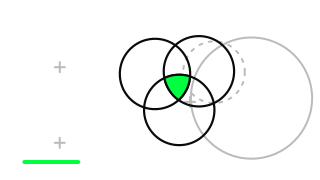
Where do the three overlap?
The overlap is wide. In all three, the page must make clear which question it answers, the answer must be written plainly enough to quote, the site must be crawlable and fast, and the identity of the author or company must be visible. None of this belongs to a single term.
That is why running three separate projects is unnecessary for most businesses. When you build a page correctly around a customer question, the same work contributes to all three. We discuss how AI summaries and rankings relate in our piece on SEO in 2026.
Where do they part?
The split is mostly one of emphasis. In SEO the target query, ranking and visits come forward. In AEO the question format, the short answer sentence and giving the answer at the very start come forward. In GEO the consistent mention of your brand and information across the various sources that AI models read comes forward.
Measurement differs as well. SEO has ranking and click data. For AEO and GEO, visibility is often click-free, so you look at indirect signals such as brand mentions and branded searches. We go into that in our pieces on measuring visibility. No answer engine is obliged to share its sources with you.
There is also the changeability of platform behaviour. When and how answer boxes and summaries are shown shifts over time, so none of the terms gives you a permanent rule set.
- SEO emphasis: query, ranking, technical base, links
- AEO emphasis: question heading, short answer, lists and tables
- GEO emphasis: your brand described consistently and accurately across many sources
Why does the argument over terms never end?
Because the interfaces have merged. A single results page can hold classic links, an answer box and an AI summary at the same time. Which abbreviation owns which of them depends on who you ask.
This vagueness is not a danger but a warning: a plan that gets stuck on the abbreviation can miss the real job. The real job is knowing what the customer asks and answering it well. The label comes afterwards.
How does a small team order its effort?
The order runs from the bottom up. First the foundation: can the site be crawled, are pages fast, is the basic page structure sound. Without that, nothing added on top will hold. You can scan for these once with our free on-page SEO audit and site speed test.
Then the question: collect customer questions and pick the ten or fifteen asked most often. For each, write a heading and a short answer directly beneath it. This step is the core of AEO and helps SEO and GEO at the same moment.
Last comes consistency: make sure your company details match across a few outside sources, such as your business profile, sector directories and your own social accounts. This is one of the things that helps GEO most.
- 1. Technical base: crawling, speed, page structure
- 2. Customer questions and pages with short answers
- 3. Heading order, lists and tables
- 4. Author, date, sources and structured data
- 5. Consistent company details on outside sources
What mistakes are common in this split?
The most common mistake is building a separate team or separate content for each abbreviation. Three versions of the same information drift into contradiction over time, and all of them weaken. One content, one source, one true text asks for less effort and is more trustworthy.
The second mistake is casting one term as the enemy of another. Lines such as 'SEO is dead' or 'AEO changed everything' tell the reader nothing and guarantee nothing. The third is accepting from an agency a guarantee tied to a term.
When is it right to lean on one of them?
If your site is new or struggling with technical problems, the weight goes to the base of SEO. If your customers ask many questions before buying and your service needs explaining, question-and-answer work in the AEO sense comes first. If your brand is known by name and people ask AI assistants 'which company', the GEO side, meaning consistency across outside sources, gains importance.
You do not need to lean on any one of them alone, though. Even on a narrow budget the same page can be written to serve all three. That means the question of which to pick is often unnecessary.
AEO, SEO and GEO are not rivals but three emphases of the same work. In a field where the borders are disputed, the sturdiest decision is to choose the work rather than the term: know the question, write the answer plainly, keep the page trustworthy and crawlable. If you would like to talk through which emphasis matters for your business, you are welcome to write to us for a discovery call with rabbitclip.
FAQ
What is the difference between AEO and SEO?
SEO is about being findable and ranked in search results. AEO focuses on being the source of the answer in interfaces that answer a question directly. Both rest on the same foundation.
Are AEO and GEO the same thing?
It is disputed in the industry, and some people use them as synonyms. In practice AEO leans on the direct-answer format, while GEO leans on being cited in AI answers.
Do I need to invest in all three separately?
For most businesses, no. A page built around a customer question, with a clear answer and trustworthy signals, contributes to all three.
Where should a small team start?
With the technical base, then pages with short answers to the ten or fifteen questions asked most often. Consistent company details on outside sources come after that.
Is SEO unnecessary now?
No. A crawlable, trustworthy site is also the base for AEO and GEO work. Dropping it weakens the other two as well.